
Sommaire

Conversational agents: what are the use cases for HR?
Just five years ago, an HR chatbot was primarily used to answer common questions and handle one-off requests. Today, conversational agents powered by generative artificial intelligence manage entire workflows : candidate pre-qualification, payroll inquiries, onboarding support, assistance with internal tools, and more. Popularized by the arrival of ChatGPT for the general public, this new generation of AI has quickly found its place in the corporate world, particularly within the HR function, which seeks to increase efficiency without sacrificing the quality of human interaction.
However, between the traditional chatbot, limited to standardized responses, and the AI agent capable of handling more complex situations, the gap has become significant. How can you distinguish between these tools? Which use cases are truly mature? And what legal and ethical precautions are necessary before deploying such virtual assistants for your employees? This article reviews the challenges, concrete applications, and keys to success for an HR conversational agent project.
What is an HR conversational agent?
Definition and operation
An HR conversational agent is a software tool capable of interacting in natural language with a company's employees, candidates, or managers to answer their questions or execute actions related to HR processes.
Its operation relies on three technological building blocks that form a coherent architecture:
- Natural Language Processing (NLP) allows the agent to understand a question asked in the user's own words, without the need for a preformatted query.
- Generative artificial intelligence, powered by Large Language Models (LLMs) like those used by ChatGPT or Claude, then makes it possible to construct a coherent response, contextualized and written in a tone appropriate for the user.
- The HR knowledge base—including internal policies, competency frameworks, collective agreements, and HRISdocumentation—serves as a reliable source of information that the agent relies on to avoid hallucinating answers.
It is the combination of these three elements, paired with fine-tuning on each company's specific HR data and practices, that distinguishes a high-performing intelligent assistant from a simple internal search engine: it understands the request, retrieves the correct information, crafts a personalized response, and can even execute actions within the HR information system.
Traditional Chatbot vs. Conversational Agent: What’s the difference?
The distinction between a traditional chatbot and a conversational AI agent is essential for understanding today's potential use cases.
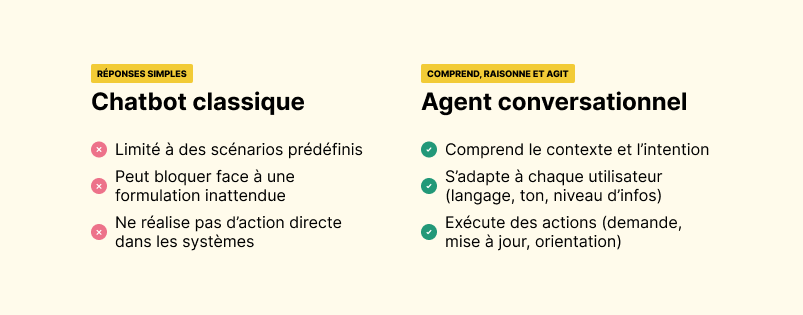
A traditional chatbot operates based on predefined rules. It is effective for simple, repetitive questions but quickly reaches its limits when faced with unexpected phrasing or situations outside its programmed scope. The user then finds themselves stuck, forced to rephrase their request or contact a human representative.
The conversational agent shifts the paradigm: beyond simply answering a question, it will reason through a request, break down a complex task into several steps, retrieve information from different systems, and act autonomously within a workflow. For example, initiating a leave request, updating data in the HRIS, or automatically routing a file to the right subject matter expert. However, it remains governed by business rules and human oversight for sensitive decisions.
From text-based chatbots to embodied conversational agents
The evolution of conversational agents is not just about their capabilities, but also about how they interact with the user. The traditional chatbot relies primarily on text : the user writes a question and receives a written response. Voice agents then add a more natural and immediate dimension through voice, allowing you to converse with the AI as you would with a person.
A new step involves embodying the agent through a face and a visual presence. The conversational agent then becomes a true digital counterpart, capable of voice-based dialogue while adding a more human and engaging dimension to the interaction.
This evolution can be broken down into three levels: chatbot = text, voice agent = voice, embodied conversational agent = face + voice. This latter approach aims to strengthen closeness and engagement during interactions, particularly when the agent guides the user through a process rather than just answering a simple question.
This evolution is where solutions like Yuzucome in, giving a physical form to the conversational agent and opening up new HR use cases, particularly in supporting employees with training or recruitment.
What are the benefits of an HR conversational agent?
For HR teams
The first benefit, and often the most visible, is time savings. A large portion of the requests received by an HR department concerns recurring, low-value questions: how to request time off, where to find a certificate, what the expense reimbursement procedure is, etc. By delegating these tasks to a conversational agent, HR teams significantly reduce their administrative burden and can focus their expertise on higher-value missions : supporting managers, talent management, and change management.
24/7 availability is a second key advantage. This continuity of service automatically improves the perceived quality HR support, without needing to mobilize additional human resources.
Finally, a well-designed conversational agent improves the quality and consistency of the responses provided. Unlike a verbal answer given by an employee based on their own interpretation of a rule, the agent systematically relies on the up-to-date documentation repository, which limits errors and inconsistencies between employees.
For employees and candidates
From the perspective of an employee, manager, or job candidate, the main benefit is immediacy : the answer arrives in seconds, at any time, on the communication channel used daily.
This speed has a direct effect on the employee experience and engagement. An employee who receives a clear and immediate answer to an administrative question feels better supported, which contributes to overall satisfaction with the employer. For candidates, a conversational agent available from the very first stages of the recruitment process strengthens the employer brand and streamlines the journey.
The autonomy gained by users is also a key point: they no longer need to systematically reach out to a human contact for simple requests, which lightens everyone's workload and streamlines the entire organization.
What are the use cases for AI agents in HR?
Administrative management
Administrative management has historically been the primary use case for conversational agents: leave and absence requests, expense report inquiries, generating certificates (employment, health insurance, etc.), and payroll questions account for a significant volume of requests that are often simple but time-consuming to process manually.
A conversational agent can respond instantly to these requests by leveraging the company's knowledge base. When connected to the HRIS, it can go even further: checking leave balances, initiating requests, forwarding documents, or routing inquiries to the right person.
This ability to move from information to action represents a major evolution compared to traditional chatbots. The agent no longer just tells an employee how to complete a task: when systems allow, it can directly help carry it out.
Onboarding and daily support
Beyond administrative tasks, a conversational agent can take over onboarding elements: guiding employees through administrative procedures, introducing the organization, and answering practical questions (tool access, useful contacts, first payday). This continuous assistance helps secure a pivotal period.
The conversational agent can also support employees throughout their time at the company. Available at any time, it can answer questions as they arise and direct users to the appropriate resources or contacts. The agent can assist employees in using internal tools, remind them of procedures to follow, or help them quickly find information in HR and business documentation.
The goal is to provide accessible, continuous support, while maintaining the ability to hand off to a human representative when a request requires expertise or personalized attention.
Recruitment and training
The recruitment process is another particularly compelling use case for conversational agents. An assistant can pre-screen applicants by asking targeted questions about their experience, skills, or availability, answer candidate questions about a job posting, schedule interviews, or send reminders to reduce no-shows.
A new dimension is emerging with embodied conversational agents. Solutions like Yuzu give the agent a face and enhance the interaction beyond just text or voice. In recruitment, this embodiment can help provide a more engaging initial interaction with the candidate.
This logic can also be applied to training and skillsdevelopment. An agent can guide an employee to the right training module based on their level, role, or needs, recommend a professional development path, or answer questions about the content provided. Here, the embodied agent opens up another possibility: make support more interactive and personalized, particularly in training or awareness programs. The agent can act as a point of contact throughout the journey, rather than just providing information on demand.
In these various use cases, the value of the agent therefore relies as much on its ability to understand and process requests as it does on the quality of the user experience provided.

How do you implement an HR chatbot in your organization?
Choosing the right solution
In response to this growing challenge, the market now offers several conversational agent solutions. The choice depends largely on the company's technical maturity and its actual needs. HR-specialized vendors offer conversational agents designed specifically for this business scope, with a knowledge base and workflows already tailored to HR issues: this is often the fastest way to implement and the safest in terms of compliance.
A decisive criterion is the integration capability with the existing HRIS . A conversational agent that only answers questions without being able to interact with the management systems in place will have a limited impact. Conversely, true integration allows for the automation of concrete actions and measurable time savings.
Key deployment steps
A successful deployment generally follows a phased approach. The pilot phase, conducted on a limited scope (a team, a site, or a specific use case like leave management), allows you to test the tool in real-world conditions, identify friction points, and adjust the knowledge base before a full-scale rollout.
The training of HR teams is a step that is too often overlooked. HR managers must understand how the agent works, know how to interpret cases where it transfers a request to a human, and be able to enrich the knowledge repository over time. This level of ownership largely determines the quality of the responses provided in the long term.
Finally, the rollout must be accompanied by clear communication to employees regarding what the agent can do, its limitations, and how to contact a human representative if needed. A transparent deployment, presented as an assistance tool and not a replacement, encourages adoption and minimizes resistance.
What is the legal and ethical framework for an HR conversational agent?
GDPR and employee data protection
By its very nature, an HR conversational agent processes sensitive personal data: payroll information, health data in certain cases, and details regarding employees' family or administrative situations. Its implementation must therefore ensure strict compliance with the GDPR.
This involves several key areas of focus : precisely defining processing purposes, limiting the retention of exchanged data to what is strictly necessary, ensuring the security of data flows between the agent and the systems it accesses, and clearly informing users about how their data is used. Choosing the right solution provider is critical here: data location, contractual processing terms, and the guaranteed level of confidentiality must be examined with the same rigor as for any other HRIStool.
Algorithmic bias and human oversight
Generative artificial intelligence models are trained on vast datasets, which exposes them to biases that can be reflected in their responses. This is particularly problematic in an HR context, where a biased response regarding recruitment, compensation, or performance reviews can have real-world consequences for the individuals involved.
The human oversight is therefore an essential principle, not an option. This requires establishing clear rules regarding which decisions the agent can make independently and which ones require systematic human validation, implementing mechanisms to analyze and monitor the responses generated, and providing a simple escalation path to an HR representative whenever a situation falls outside the agent's scope of competence. The goal is not to limit the tool's performance, but to ensure it remains a tool that supports human decision-making, rather than an autonomous system for high-impact matters.
What is the impact on the future of the HR function?
HR augmented rather than replaced
Contrary to a common fear, conversational agents are not intended to replace HR teams, but to transform the nature of their role. By handling simple and repetitive requests, they free up time for tasks that require human judgment, empathy, or specialized expertise: supporting complex individual situations, providing strategic advice to managers, and leading transformation projects.
This evolution is accompanied by an upskilling expected of the HR function itself, which must develop a better command of digital tools and the ability to steer these new systems rather than just being subject to them. The HR professional of tomorrow will be less of a process executor and more of an experience architect, capable of leveraging artificial intelligence to enhance the quality of the relationship with employees.
The current limitations of HR conversational agents
However, it would be misleading to present these tools as a universal solution. Their performance depends directly on the quality and currency of the documentation repository they rely on : an agent fed by an obsolete or incomplete knowledge base will produce erroneous answers, which can have a more negative effect than no answer at all.
Furthermore, certain situations will remain permanently beyond the reach of automated processing: subjects with a high emotional charge, interpersonal conflicts, and decisions related to performance management or contract termination require a level of listening and nuance that AI, no matter how sophisticated, cannot replace through human support. Finally, the acceptance of these tools by employees is not a given; it is built gradually through demonstrating their real utility and ensuring that human recourse always remains an option.
Conclusion
Conversational agents have moved beyond the stage of being a technological gadget to become a true driver of efficiency for HR functions. What was, until recently, just a tool for providing automated answers to simple questions is evolving into a genuine assistant capable of reasoning, interacting with information systems, and supporting entire processes from recruitment to training, as well as day-to-day administrative management.
This transformation requires choosing a solution tailored to the company's technical maturity and ensuring seamless integration with the HRISsoftware. It also requires establishing a solid legal framework in compliance with GDPR, and maintaining constant human oversight over decisions that impact employees. Only under these conditions can the tool deliver on its promises.
When well-designed, these conversational agents do not replace the human connection at the heart of the HR function, but rather refocus it on what matters most. By taking over the handling of repetitive requests, they free up the time HR teams need for what no artificial intelligence will ever be able to do in their place: listening, mediating, and providing support.
But the evolution of these agents is not just about their capabilities. It also concerns the way employees and candidates interact with them. Following text-based chatbots and voice agents, the emergence of embodied conversational agents, such as those offered by Yuzu, opens up a new dimension: an interaction that combines conversation, voice, and visual presence. In HR applications, this evolution can help make certain processes, particularly recruitment or training, more interactive and personalized.
At a time when generative AI is becoming standard across almost every business function, the real question is no longer whether to adopt an HR conversational agent, but how to use it to create a truly more human employee experience.